

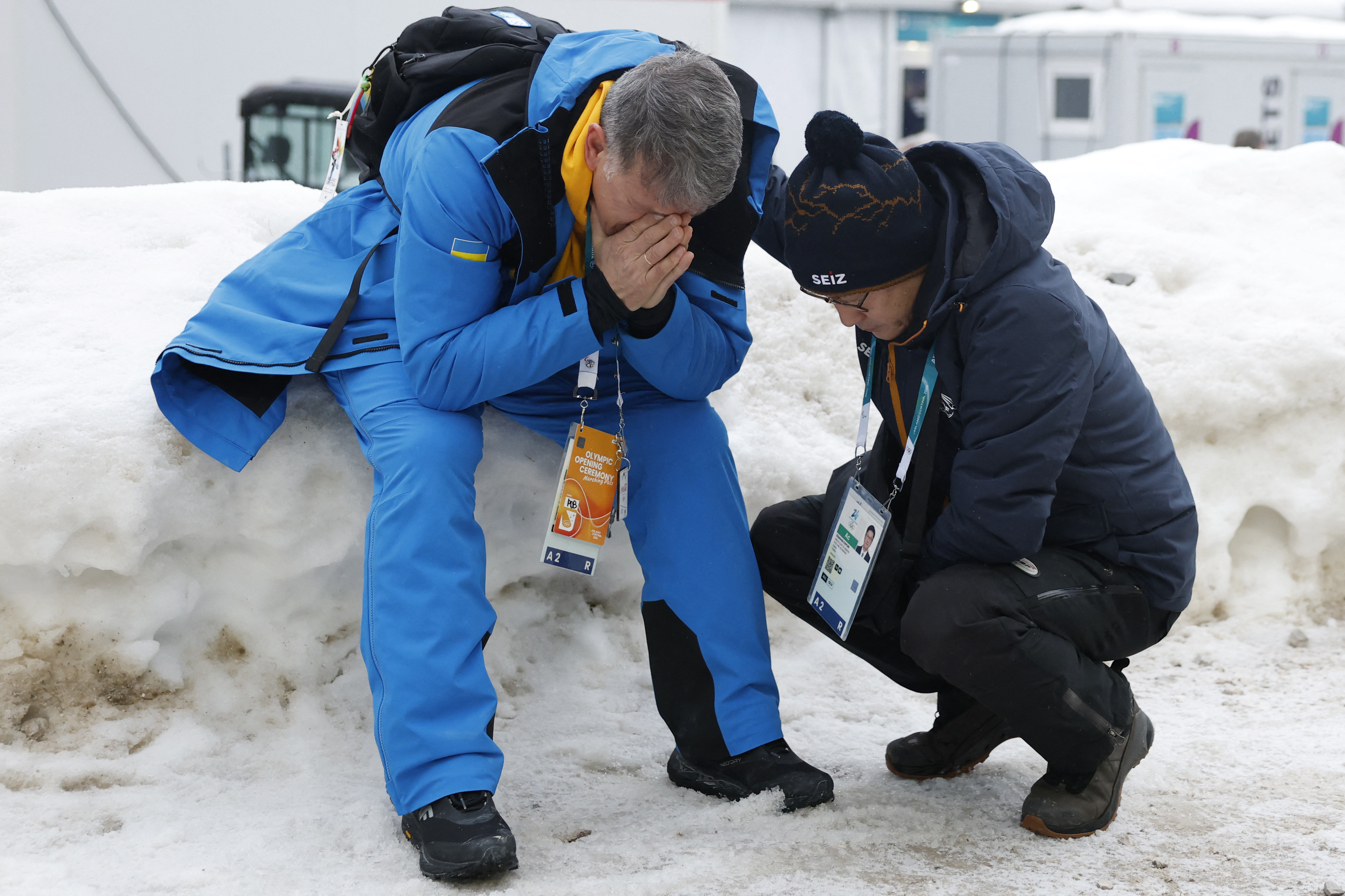
Ukrainian skeleton athlete Vladyslav Heraskevych was banned from racing Thursday in the Milan Cortina Olympics after insisting on wearing a helmet that pays tribute to more than 20 athletes and coaches killed in his country’s war with Russia.
The International Olympic Committee announced the decision just before the men’s individual competition, where Heraskevych had been a contender for a medal, saying it breaks rules against making statements on the field of play.
“The International Olympic Committee destroyed our dreams,” said Mykhailo Heraskevych, the slider’s coach and father. “It’s not fair.”
Mykhailo was visibly emotional outside the sliding arena in Cortina d’Ampezzo.
Vladyslav Heraskevych confirmed that he planned to compete with his banned helmet commemorating athletes killed in the war with Russia.
Heraskevych was set to race in the first heat of the men’s skeleton, but 45 minutes before competition began IOC President Kirsty Coventry turned up at the sliding track in a last-minute bid to change his mind on wearing the helmet. The two met privately for about 10 minutes.
“We didn’t find common ground in this regard,” Heraskevych said.
Coventry appeared visibly emotional after the meeting, with tears seen rolling down her face.The Olympic champion swimmer made clear that she wanted a different outcome, and the IOC said the decision was made with regret.
“As you’ve all seen over the last few days, we’ve allowed for Vladyslav to use his helmet in training,” Coventry said. “No one, no one — especially me — is disagreeing with the messaging. The messaging is a powerful message. It’s a message of remembrance. It’s a message of memory and no one is disagreeing with that. The challenge that we are facing is that we wanted to ask or come up with a solution for just the field of play.”
The two agreed that the helmet isn’t clearly visible during races anyway, given that sliders are zipping down the icy chute at around 120 kph (75 mph). That, the IOC hoped, was the window to a compromise. But Heraskevych would not budge.
“I believe they deserve to be here,” Heraskevych told reporters about his insistence on wearing the helmet. “Because of their sacrifice, we are able to be here today and I want to honor them and their families.”
Heraskevych said it “looks like discrimination” to bar him from competing, pointing to what he believes are inconsistencies in how the IOC decides what statements are allowed. Among the examples he cited are U.S. figure skater Maxim Naumov bringing a photo of his late parents — who were among the 67 people killed in a plane crash on Jan. 29, 2025 — to the kiss-and-cry area after his skate in Milan this week, and Israeli skeleton athlete Jared Firestone’s decision to appear at the opening ceremony wearing a kippah that bore the names of 11 Israeli athletes and coaches killed in the 1972 attack during the Munich Games.
“A competitor literally placed the memory of the dead on his head to honor them,” Heraskevych wrote on Instagram. “I frankly do not understand how these two cases are fundamentally different.”
Heraskevych said he would appeal to the Court of Arbitration for Sport, but the race went on without him. The first two runs were Thursday, the last two are Friday. Regardless of what CAS says, if anything, his chance to race in these Games is gone. The IOC is letting him keep his credential, meaning he can remain at the Olympics as an athlete — just not a competing one.
Allison Craig is a passionate sports writer and analyst with a deep love for game strategies, player performances, and the latest trends in the sports world. With years of experience covering football, basketball, tennis, and more, she delivers insightful analysis and engaging content for sports enthusiasts.
No responses yet